One Large Billboard vs Multiple Billboards: Which Delivers Better OOH Results?
When implementing outdoor advertising, one of the most common questions businesses often ask is whether they should invest in one large billboard in a prominent location or allocate their budget to multiple medium-sized billboards across different roads. This is not simply a matter of billboard size or quantity. In reality, it is closely related to the communication strategy and objectives of the campaign.
 In practice, many brands that begin using outdoor advertising tend to assume that the larger the billboard, the more effective it will be. However, this is not always the case. Some campaigns achieve excellent results with just a single large billboard placed in a strategic location, while in other cases, deploying multiple medium-sized billboards along different routes can provide better brand coverage. Therefore, rather than simply comparing size and quantity, it is more useful to look at the issue from a strategic perspective. Let’s explore this together with Firstboard to understand when a single large billboard is the right choice and when multiple medium-sized billboards can deliver better results for an outdoor advertising campaign.
When a large billboard becomes the highlight of a campaign
First, a large billboard placed in a prime location often delivers strong results when the objective of the campaign is to capture attention immediately and create a clear impression in the minds of viewers. In crowded urban environments where many visual elements compete for attention every day, the size of a billboard plays an important role in helping the message stand out from its surroundings.
One clear advantage of a large billboard is its visibility from a long distance. When people are moving quickly through traffic, they often only have a few seconds to notice and process an advertisement. In this situation, a billboard with a large format, clear design, and suitable placement can help a brand attract attention from the very first moment of exposure. Beyond simply attracting attention, large billboards can also create a strong visual impact within the urban environment. When placed at busy intersections or along major traffic routes, a billboard can become a noticeable visual element in the surrounding landscape. As a result, the advertisement becomes not only a communication message but also a memorable visual presence for people passing by. For this reason, the strategy of using one large billboard is often applied in campaigns such as product launches, brand repositioning, or large-scale branding campaigns. In these situations, brands do not necessarily need to appear in many locations. Instead, they focus on creating a powerful “spotlight” point that captures attention and leaves a strong impression.
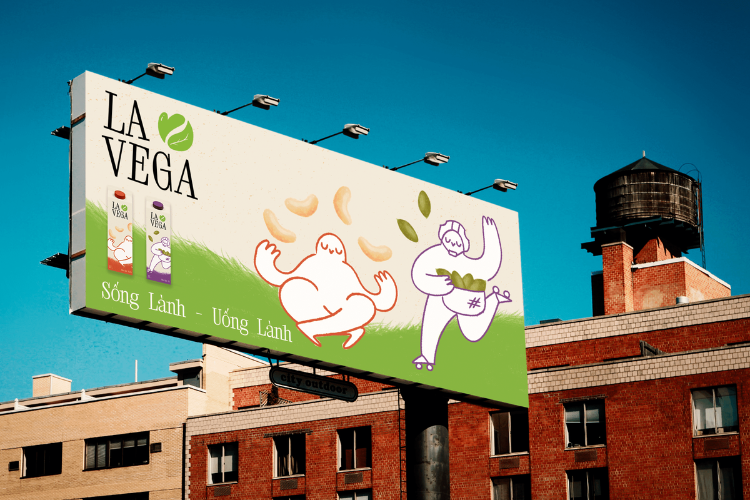
Another benefit of large billboards is their ability to enhance brand image. When a brand appears on prominent large-format billboards in highly visible locations across the city, viewers often perceive the campaign as well-invested and professionally executed. This can help strengthen perceptions of the brand’s scale and credibility.
However, this strategy also has certain limitations. When a campaign relies on a single billboard in one location, the frequency of exposure may be lower compared with campaigns that use multiple placements. If consumers do not regularly travel through that area, they may only see the advertisement once. In addition, the reach of a large billboard depends heavily on traffic flow at the location where it is installed. No matter how visually striking the billboard is, its effectiveness may still be limited if the location does not align with the typical travel routes of the target audience.
When multiple medium billboards help increase brand reach
In contrast to focusing on one large billboard, many brands choose to deploy multiple medium-sized billboards across different roads. This approach does not aim to create a single focal point. Instead, it focuses on increasing the number of times consumers see the advertisement during their daily journeys. In marketing, message repetition plays an important role in building brand recognition. When people encounter the same advertisement in several different locations, their ability to remember the brand is usually higher than if they see the advertisement only once. This is why the strategy of using multiple medium-sized billboards is often applied in campaigns that aim to expand brand reach or maintain brand presence over a longer period of time. Rather than concentrating on a single location, the brand appears across multiple routes to maximize the number of exposures to audiences.

One key strength of this approach is its ability to reach customers across different areas. For example, a campaign may place billboards near office districts, residential areas, and main roads leading into the city center. As a result, the advertisement can appear in several different travel contexts within consumers’ daily routines. In addition, deploying multiple billboards also makes the campaign more flexible in terms of location selection. If certain areas have higher traffic volume or better match the target audience, brands can prioritize placing billboards in those locations to improve communication effectiveness.
However, this strategy also has some limitations. Compared with large-format billboards, medium-sized ones may not create the same strong visual impact. In urban environments filled with signs and advertisements, medium-sized billboards can sometimes blend into the background if the design is not distinctive enough. Furthermore, when multiple billboard locations are implemented at the same time, campaign management and monitoring need to be handled more carefully. Businesses must ensure that the advertisement design fits the size of each billboard and that the placement still maintains good visibility for viewers.
So should you choose one large billboard or 5 medium ones?
After considering these factors, it becomes clear that there is no single best option for every outdoor advertising campaign. The effectiveness of OOH depends greatly on the campaign’s communication objectives, the movement patterns of the target audience, and the overall implementation strategy of the brand. If a business wants to create a strong impression and capture attention quickly, a large billboard in a prime location can deliver a noticeable impact. This option is especially suitable for branding campaigns or product launches where the brand needs a striking visual presence to attract attention.
On the other hand, if the objective of the campaign is to increase reach and appear multiple times along the customer’s travel journey, deploying several medium-sized billboards can help the brand reach more people across different routes. The repetition effect of the message can gradually strengthen brand recall over time.
 In some cases, many successful OOH campaigns even combine both strategies. A large billboard is used to create a strong visual highlight for the campaign, while medium-sized billboards are deployed across multiple routes to expand coverage. This approach allows the campaign to achieve both strong visual impact and sufficient frequency of exposure.
If businesses are considering implementing outdoor advertising but are not sure which approach to choose, Firstboard can help analyze locations, understand customer movement patterns, and propose a billboard strategy that fits the campaign’s objectives. Choosing the right approach from the beginning can help optimize budgets and improve overall communication effectiveness. Contact Firstboard today to receive consultation and find the most suitable OOH solution for your campaign.
Picture credit: Pexels