Britannia’s OOH Campaign: When Billboards Stop Dominating Space and Start Belonging to It
For years, Out-of-Home advertising has operated on a simple premise: the more space a brand occupies, the more visible it becomes. Bigger billboards, premium locations, higher frequency, these have long been the default levers for maximizing impact.
But visibility is no longer the constraint.
In a landscape saturated with stimuli, consumers are not lacking exposure. What they lack is a reason to care.
This is where Britannia’s “Nature Shapes” campaign marks a significant shift. It does not attempt to optimize OOH as a display channel. Instead, it redefines it as a medium through which brands can demonstrate behavior in the physical world.
When Advertising Becomes an Intrusion
One of the inherent tensions in outdoor advertisng lies in its relationship with public space. To exist, billboards often displace something else—sometimes subtly, sometimes visibly. Trees are trimmed, urban landscapes are altered, and over time, advertising begins to feel less like a neutral presence and more like an imposition.
Consumers may not consciously articulate this discomfort, but they register it.
Britannia’s insight emerges precisely from this tension. Rather than ignoring or masking it, the brand acknowledges the underlying conflict and reframes the problem: if advertising is perceived as encroaching on nature, can it instead adapt to it?
“Nature Shapes”: When the Environment Becomes the Creative Director
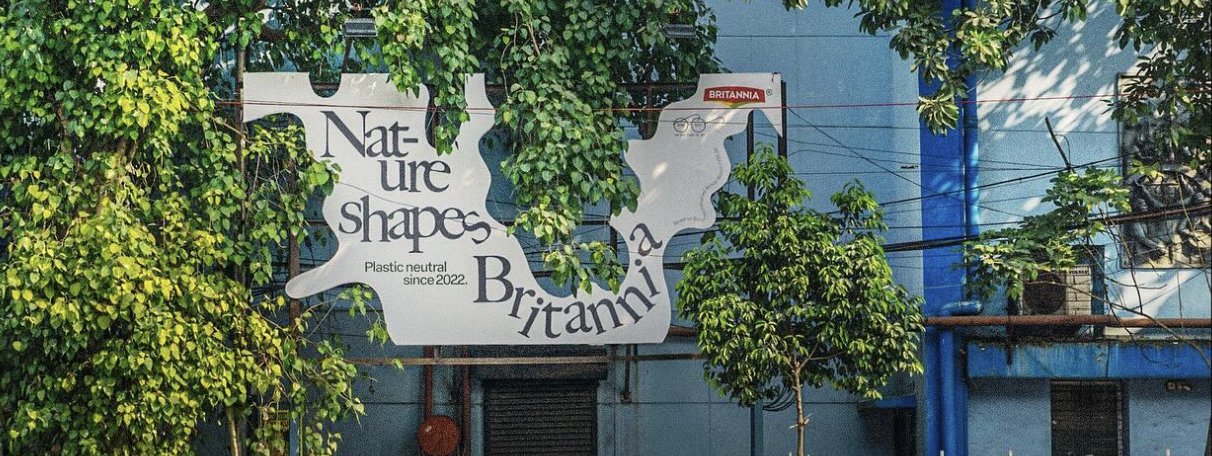
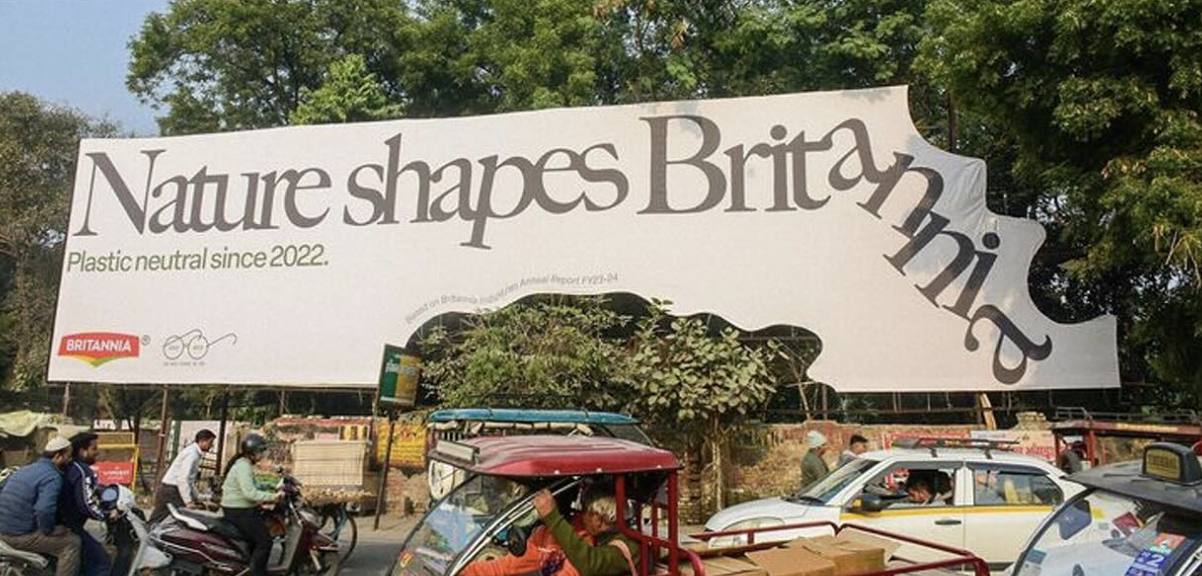
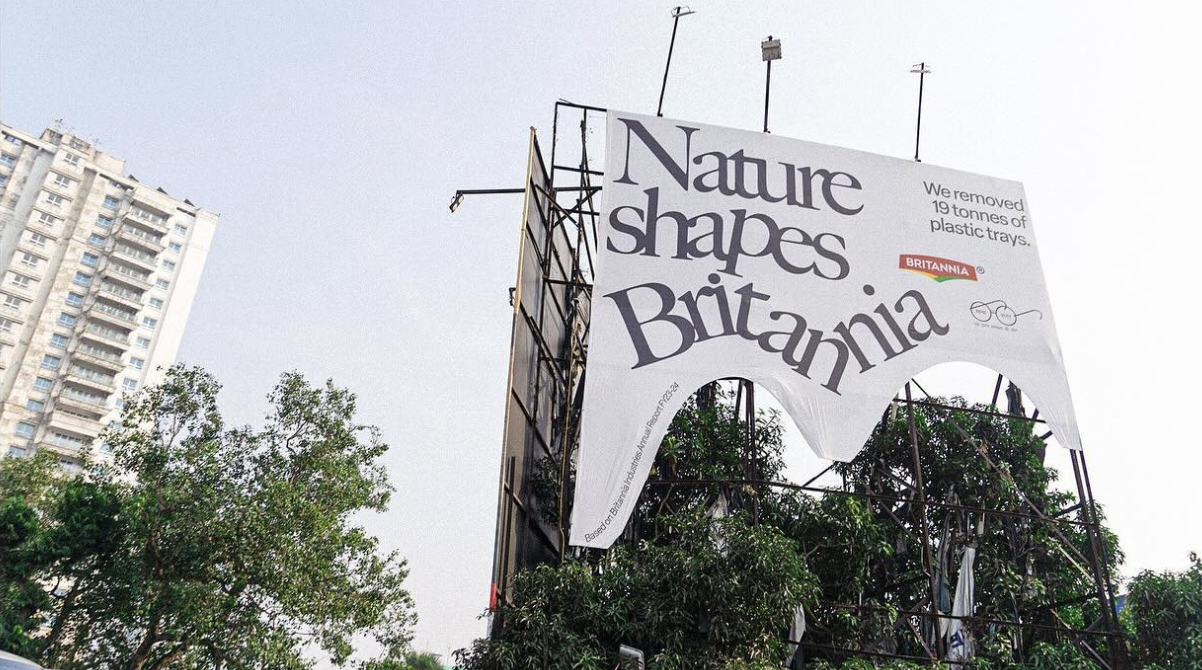
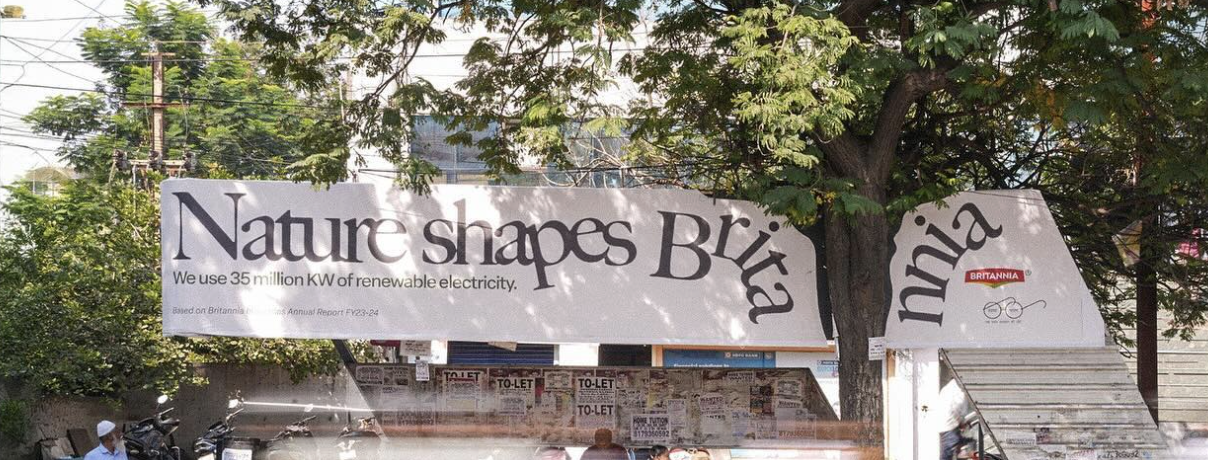
The execution is deceptively simple. Instead of clearing space for billboards, Britannia redesigned the billboards to accommodate existing trees. Structures were cut, reshaped, and adjusted to allow trunks and foliage to pass through them naturally.
The result is a series of installations where no two billboards look the same. Each one is directly informed by its immediate environment, creating a visual language that is inherently contextual rather than standardized.
What matters here is not the novelty of the form, but the logic behind it. Britannia relinquishes total control over the format and allows nature to co-author the final output. In doing so, the campaign moves beyond communication into the realm of brand behavior—where the brand’s values are not stated, but enacted.
Contextual OOH: Moving Beyond Location to Meaning
In most OOH campaign, location is treated as the primary variable. High-traffic intersections, arterial roads, and commercial hubs are prioritized to maximize exposure.
Britannia extends this thinking further by engaging with contextual OOH in its truest sense.
Context is no longer limited to audience density or movement patterns. It includes the physical characteristics of the space itself. Elements that would typically be considered constraints—such as trees—are reframed as assets.
This shift fundamentally alters how the audience interacts with the medium. Instead of passively registering a familiar format, viewers encounter something unexpected. The disruption is subtle but powerful, forcing a moment of cognitive engagement.
In low-attention environments, this kind of interruption is far more valuable than repeated exposure to predictable visuals.
From Visibility to Behavior: Why the Campaign Works
Evaluating this campaign through traditional media metrics like reach and frequency would miss the point. Its effectiveness lies in how it redefines the function of OOH Marketing.
First, it replaces messaging with action. The campaign does not tell audiences that the brand cares about sustainability—it demonstrates it in a tangible, visible way. This transition from narrative to proof enhances credibility in a way that conventional communication struggles to achieve.
Second, it leverages visual distinctiveness to generate organic amplification. A billboard that breaks its own frame naturally invites documentation and sharing. As a result, the campaign extends beyond physical locations into digital spaces, creating earned media without relying solely on paid distribution.
Third, it strengthens mental availalibity through memorability rather than repetition. Instead of aiming to be seen more often, the campaign ensures that when it is seen, it leaves a lasting impression. This is a critical distinction in an era where attention is both fragmented and selective.
Redefining Industry Principles
From a strategic standpoint, the campaign challenges several long-standing assumptions in creative billboard execution.
It suggests that the environment should not be treated as a backdrop, but as an integral component of the message. When advertising integrates with its surroundings, it becomes less intrusive and more meaningful.
It demonstrates that constraints can be reframed as creative opportunities. What was once an obstacle becomes a defining feature of the experience.
It also redefines consistency. Instead of uniform visuals across placements, consistency is achieved at the level of idea. Each execution may differ in form, but all remain aligned in intent.
The Future of OOH: From Dominance to Coexistence
“Nature Shapes” does not imply that every brand should replicate its execution. Its significance lies in the direction it signals for outdoor advertisng as a whole.
As urban environments become more complex and audiences more discerning, the effectiveness of OOH will increasingly depend on how well brands understand and respond to the spaces they inhabit.
The question is no longer how to dominate attention, but how to earn it.
This requires a shift in planning logic. Instead of starting with available inventory, brands must begin with the experience they want to create. What is unique about a given space, and how can that uniqueness be leveraged to produce meaning?
Conclusion
Britannia’s OOH campaign is not simply a creative success. It is a reminder that in a world where advertising is ubiquitous, differentiation does not come from being louder or larger.
It comes from being more intentional.
When a billboard stops competing for attention and starts offering a reason to engage, the role of OOH changes fundamentally. It becomes more than a surface for messaging—it becomes a reflection of how a brand chooses to exist in the real world.
And in the evolving landscape of OOH marketing that may be the most valuable position a brand can occupy.
If you're planning an OOH campaign in Vietnam, Firstboard can help you design a strategy that aligns with real-world context-from planning to execution.