Cost of billboards in Vietnam 2026
When brands begin exploring outdoor advertising, the first thing they almost always ask about is price. Not ideas. Not creative execution. The total cost. That is completely understandable. OOH usually involves a sizable budget, long booking periods, and results that are not as immediately visible as digital ads.
In reality, there is no single fixed price list for OOH. Two billboards may look similar at first glance, yet one costs a few hundred million VND per year while another reaches several billion. Where does that difference come from? And what price level actually makes sense for a brand’s objective?
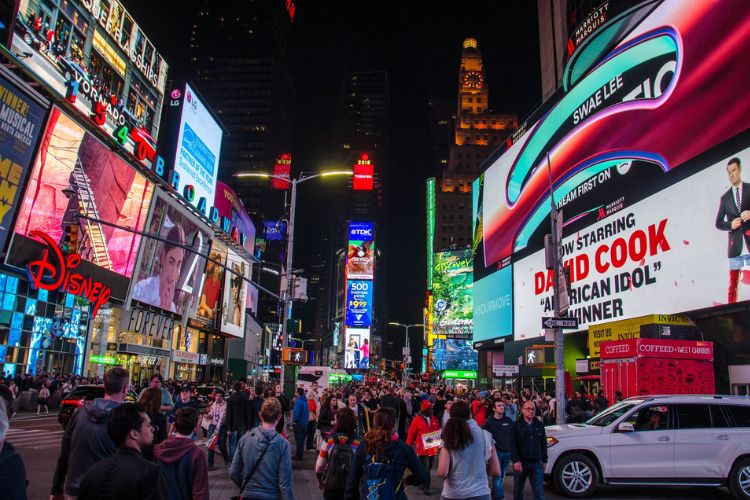
This blog summarizes the outdoor advertising (OOH) price landscape in Vietnam for 2026, broken down by the most common formats, so businesses can better visualize the real budget required to launch a campaign. Together with Firstboard, let’s take a closer look at the OOH formats and the price ranges currently applied in the market.
Why outdoor advertising prices are never the same?
OOH does not work like digital advertising, where a budget can be set and activated almost instantly. Outdoor advertising costs are built from multiple layers, and a small change in just one factor can significantly shift the final price.
The first factor is geography. Ho Chi Minh City and Hanoi consistently have higher price levels due to dense traffic, strong competition, and high demand for premium locations. In other provinces, the same type of billboard can be significantly more affordable.
Next comes the specific location. This directly affects how many people actually see the ad. Intersections with heavy traffic, areas where vehicles regularly stop at red lights, or roads with high daily traffic volumes naturally generate more visibility. As exposure increases, rental prices rise accordingly.
Finally, there are technical and operational factors: rental duration, billboard size, printing costs, construction, installation, and ongoing maintenance. All of these components combine to form the final figure a business needs to prepare for an OOH campaign.
High-level outdoor advertising
Unipole billboards
The most common type of outdoor advertising is the unipole billboard. These are erected using a single large steel pole and are usually erected along highways, entrances to cities, or interprovincial highways. Due to their height and size, unipoles can be seen from a distance. Based on the design and location, a unipole billboard can have one, two, or three advertising faces. The more faces, the wider visibility and, of course, the higher costs.

In 2026, the cost of a unipole billboard is estimated to be between VND 800 million and VND 3 billion per year. This type of billboard is commonly used for long-term advertising campaigns, where the objective is to create a strong and continuous presence, rather than an immediate response.
Wall-mounted pano billboards
Wall-mounted Pano billboards are mounted directly onto the sides of large buildings or high-rise buildings. Unlike Unipoles, Pano billboards usually only have one side, but they make up for it with the large space they offer for advertising and the least obstructions when mounted correctly.
However, the use of pano billboards is heavily dependent on the angles at which they are viewed and the flow of traffic in front of the building. Some pano billboards are mounted along the road where people pass daily, seeing the same information multiple times a day - though only for a few seconds at a time. Thus, the cost of wall-mounted pano billboards ranges from VND 400 million to VND 2 billion annually.
Pedestrian bridge advertising
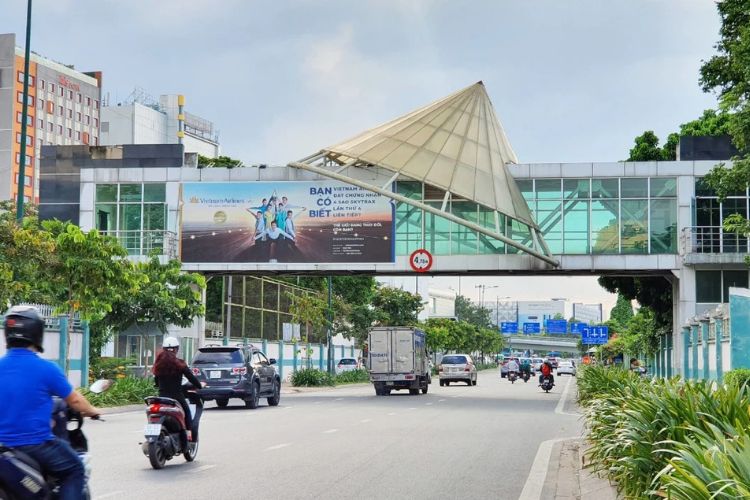
In Hanoi especially, pedestrian bridge advertising is a familiar sight. Ads are placed directly on the bridge structure, usually as a pair of boards on both sides, facing traffic moving below at slower speeds.
The main advantage of this format is contact frequency. Daily commuters see the same message at the same spot, building familiarity quickly over time.
The price for advertising on pedestrian bridges usually varies from VND 500 million to VND 4 billion per year. This type of advertising is preferred by companies that want to be the market leaders in the inner city.
Low-level outdoor advertising
Lightbox advertising
Lightbox advertising is one of the most popular low-level OOH advertising mediums in Vietnam. Lightbox advertising is usually placed along inner-city streets, residential areas, sidewalks, and roads where there is high volume movement. The distinguishing feature of lightbox advertising is the lighting, which ensures that the images are clear during the night as well as the day.
Since lightbox advertising is placed at eye level and along familiar routes, it enables brands to reach consumers repeatedly. People do not need to stop and look closely; repeated exposure makes the brand gradually feel familiar. For this reason, lightboxes are often used in campaigns focused on maintaining consistent local presence.
The prices of lightboxes range between VND 100 million and VND 2 billion per board per year depending on the street location and area of the city.
E-Tower Panel
E-Tower Panels are small-format outdoor lightbox mounted directly on power poles or transformer poles in residential neighborhoods and inner-city streets. They are easy to recognize due to their compact size and frequent repetition along urban routes.
With screens placed at close viewing distance, E-tower panels display content clearly in slow-moving traffic or densely populated areas. This format is commonly used to build coverage within specific neighborhoods rather than to create large-scale visual impact.
The price for E-tower panels in the current market is around VND 300 million per year, depending on the location where the system is installed.
Location-based advertising
Location-based outdoor advertising involves advertising within enclosed environments such as airports and shopping centers. This includes areas such as waiting lounges, check-in counters, baggage reclaim areas, security gates, entrances and exits, main areas of the shopping center, escalators, and corridors. Such environments are well trafficked and offer good visibility to business travelers, high-income groups, and consumers with high shopping and entertainment needs.
Across these venues, advertising formats vary widely, including LED screens, LCD displays, TV screens, in-elevator panels, lightboxes, and large-format panels, depending on the specific placement area.
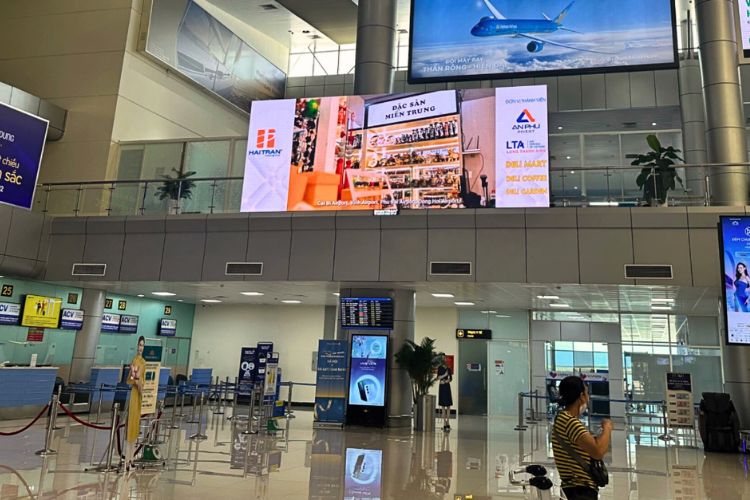
The cost of advertising varies depending on the specific location (airports or shopping malls), position of placement, and duration of rental. At airports, the cost is normally calculated on a weekly basis and varies between VND 6 million and VND 300 million per week. At shopping malls, the cost is normally calculated on a monthly basis, and the market rate varies between VND 45 million and VND 600 million per month.
Digital Out-of-Home (DOOH)
LED screens
LED screen refers to a digital advertising display usually located at major intersections, city centers, or other areas of high human traffic within the city. The ads are played sequentially, with each ad lasting approximately 15 to 30 seconds and running approximately 120 to 240 spots daily.
Unlike static boards, which are rented for long periods of time, LED screens are rented for shorter periods of time and are thus more suitable for product launches. The weekly rental fee for LED screen ranges between VND 22 million and VND 100 million depending on the area and frequency of playback.
LCD screen networks
LCD screens are commonly found in elevators, office building lobbies, residential complexes, and indoor spaces with consistent foot traffic. Viewers are typically at close range and often waiting, which increases the chance of message absorption.
LCD advertising is usually priced by screen network, with market rates around VND 25 million per week per layout, depending on screen count and coverage area.
Each type of OOH media has different features in terms of price and the best use for different marketing objectives. By understanding the difference between the types of media, businesses are able to choose the most appropriate one for the best result.
For more information, connect with Firstboard to review OOH locations, formats, and budget options in detail. Get in touch with us here!
Picture credit: Vecom, Hai Tran Media & Airs, Presson, BrandsVietnam