Taxi Advertising Vietnam: VND 1–4M per Car a Month
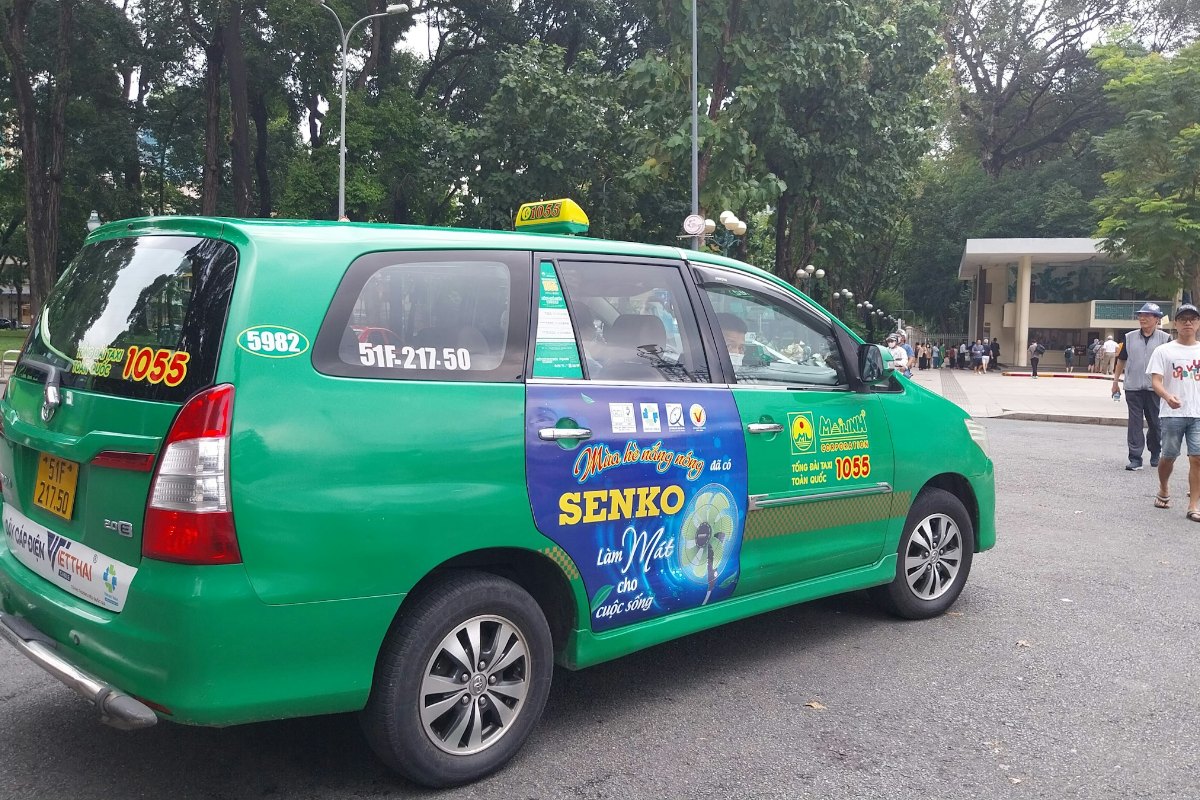
Taxi advertising in Vietnam means branded decals on a taxi's doors and side panels, or posters and seat-back pockets inside the car, and published rates run from about VND 1 million to VND 4 million per car per month for exterior decals, depending on the taxi brand and panel size. Brands that want cars on the road through the Tết 2027 shopping season (the first day of Tết falls on Saturday, 6 February 2027) should confirm fleets, car numbers and artwork in December.
Below: why taxis matter now, ad positions, a brand-by-brand rate table (as of November 2026), minimums, the legal limits and a timeline.
Why taxi advertising in Vietnam is worth a look now
Taxis spend the whole day moving between city centres, airports, office districts and malls, so a brand gets repeated exposure exactly where its customers are. The market has also changed fast:
- A large, mostly electric fleet: as of June 2026, Vietnam had 86,274 taxis, 61,171 of them electric, or 70.9%, according to figures presented at a Ministry of Construction conference on 17 September 2026 (Giáo dục Việt Nam). Newer cars make a cleaner canvas for brands.
- Green SM now carries ads: Green SM, formerly Xanh SM, held 54.51% of Vietnam's ride-hailing taxi market in the first quarter of 2026, according to Mordor Intelligence (VnEconomy). Since 2 July 2026 it has paid an allowance, nationwide, to drivers who sign up for advertising campaigns on their cars (Green SM), and since 7 September its driver app has a feature for assigning and removing ads and sending installation proof (Green SM).
- Hanoi is going fully electric: the capital aims to convert its entire taxi fleet to electric by 2030 (Hanoi city portal).
Where ads go on a taxi
- Two rear doors: the most common format. Vinasun's sizes: 1,000 × 800 mm (4-seater), 1,100 × 850 mm (7-seater).
- Two rear doors extended to the rear quarter panel: nearly double the area, 1,800 × 900 mm (4-seater) and 2,000 × 950 mm (7-seater).
- Four doors: both sides of the car, 2,200 × 860 mm (4-seater) and 2,240 × 980 mm (7-seater).
- Triangle and side windows: small, cheap, good for logo reminders.
- Inside the car: posters, seat-back pockets or leaflets, seen for the whole ride; good for QR codes.
Sizes from Vinasun's advertising service page; other fleets differ. For a comparison with buses, see our bus advertising guide for HCMC and Hanoi.
How much does taxi advertising cost in Vietnam?
Rates below are in VND per car per month for 4-seaters, before tax, as compiled by NCA:
| Taxi brand | Two rear doors | Rear doors + quarter panel | Four doors | Poster + seat pocket |
|---|---|---|---|---|
| Mai Linh | 1,600,000 | 2,800,000 | 3,000,000 | 500,000–800,000 |
| Vinasun | 1,700,000 | 2,900,000 | 3,000,000 | 500,000–700,000 |
| G7 | 1,900,000 | 2,500,000 | 3,100,000 | 500,000–700,000 |
| Taxi Group | 1,550,000 | 2,300,000 | 2,900,000 | 600,000 |
| Open 99 | 1,550,000 | 2,300,000 | 3,300,000 | 600,000 |
| Vina Taxi | 1,150,000 | 1,750,000 | Not offered | 450,000 |
| Tiên Sa | 1,350,000 | 1,750,000 | Not offered | 500,000 |
| VIC | 1,050,000 | 1,750,000 | Not offered | Not offered |
| Green SM | Ask Firstboard for a quote by car numbers and campaign length | |||
Source: NCA, "What is taxi advertising" (Vietnamese; updated 8 September 2026; indicative prices). 7-seaters cost more; four-door decals on Mai Linh and Vinasun 7-seaters are VND 4,000,000 per car per month. Ask whether a quote includes printing, installation, maintenance and VAT. For roadside costs, see our billboard cost guide for Vietnam.
Minimum fleet size and campaign length
Vinasun says taxi campaigns usually run for at least two months on at least 50 cars to ensure coverage (Vinasun). NCA recommends at least 100 cars for three months for strong visibility. On a tight budget, concentrate cars in one city rather than spreading them thinly across provinces.
The legal rules for taxi advertising in Vietnam
- Position and area: under Article 32(2) of the 2012 Advertising Law, ads may not appear on the front, rear or roof of a vehicle, and may cover no more than 50% of each side where advertising is allowed. Some packages on the market include tail or rear-window areas, so ask the seller to confirm the decal stays within the permitted area.
- 2025 amendment: Law No. 75/2025/QH15, in force since 1 January 2026, left Article 32 unchanged. The new implementing decree, Decree 342/2025/ND-CP, replaced Decree 181/2013/ND-CP from 15 February 2026.
- Penalties: under Decree 87/2026/ND-CP (issued 27 March 2026, in force since 15 May 2026, replacing Decree 38/2021/ND-CP), ads on the front, rear or roof of a vehicle, or over the permitted area of a side, draw a fine of VND 2–5 million. That is the rate for individuals; organisations pay double.
- Content: the lists of banned and restricted products still apply, such as tobacco and spirits of 15% ABV or more. Leave room for the taxi company's own markings (logo, name, hotline); the fleet approves artwork before installation.
Choosing fleets and cities
- By geography: each fleet is strong in different places, for example Tiên Sa in Da Nang, while Mai Linh, Vinasun, G7 and Taxi Group focus on the big cities. Ask for car lists and actual operating areas.
- By brand fit: electric taxis suit technology and sustainability messages; traditional fleets cluster at airports, hospitals and bus stations.
- With fixed sites: taxis reach widely but pass quickly. Pair them with billboards on airport roads or main corridors for repetition; see outdoor advertising formats worth considering in Vietnam and our metro advertising guide.
Timeline for Tết 2027
- Early December 2026: choose fleets, cities and car numbers; send artwork for approval.
- Mid-December 2026: print and install so cars run from late December, covering Christmas, New Year and year-end bonus season.
- January 2027 to 6 February 2027: the Tết shopping peak, with heavy travel to airports and bus stations.
- After Tết: keep new-year messaging running on contracts of three months or more.
FAQ: taxi advertising in Vietnam
How much does taxi advertising cost in Vietnam?
NCA's indicative table (September 2026) puts exterior decals on 4-seaters at about VND 1.05–3.3 million per car per month, and up to VND 4 million on 7-seaters. Interior posters and seat pockets are about VND 450,000–800,000.
Can I wrap a whole taxi in Vietnam?
No. The Advertising Law bans ads on the front, rear and roof and caps ads at 50% of each permitted side.
How many taxis do I need?
Vinasun's minimum is 50 cars for two months; many agencies recommend 100 cars for three months for good coverage.
Do electric taxis accept advertising?
Yes. Green SM has run a programme for drivers to join on-car advertising campaigns since July 2026.
Can I book taxi advertising through Firstboard?
Yes. Firstboard works with taxi-media partners in Vietnam, including the Green SM electric fleet, and can combine taxis with billboards and airport screens in one plan.
Locations near airports and city centres in HCMC and Hanoi
Pair taxis with fixed sites where taxis pick up and drop off most:
- 1 Sided Horizontal LED Screen Billboard at Tan Son Nhat International Airport, Ho Chi Minh City (Taxi Pick Up Area)
- 1 Panel Horizontal Unipole Billboard at 60c Truong Son, Tan Binh, Ho Chi Minh City (located directly opposite the exit of Tan Son Nhat International Airport)
- 1 Panel Horizontal Light Box Billboard at Tan Son Nhat Airport, Tan Binh, Ho Chi Minh City (Tan Son Nhat Airport exit gate to the city center)
- 1 Sided Horizontal Wallscape Billboard at 132 Ham Nghi, District 1, Ho Chi Minh City (Floors 14-15-16)
- 1 Sided Horizontal Airport LED Screen Billboard at Noi Bai International Airport, Ha Noi City (Hall C)
Browse every site on Firstboard search or request a quote.
Plan your campaign with Firstboard
The Firstboard Vietnam team helps brands and agencies plan outdoor campaigns in Ho Chi Minh City, Hanoi and beyond, from billboards and LED screens to airport media. Through our taxi-media partners, including the Green SM electric fleet, we can add taxis to the same plan. Build your own plan with the e-proposal builder and track the campaign online. Running across several countries? SEA Network brings Vietnam, Malaysia, Singapore, Indonesia, Thailand and the Philippines into one media plan.