The Joy of OOH Ads: How Interactive Billboards Are Changing the Game
Why Most OOH Campaigns Get Noticed… But Not Remembered
You have probably driven past hundreds of billboards this month.
Let’s face it, how many do you really remember?
That’s the challenge most brands are facing right now. OOH still delivers reach, but attention? That’s getting tougher. In my media planning campaign experience, I have seen premium locations still underperform simply because… they didn’t give people a reason to care.
This is exactly where interactive OOH campaign strategies begin to change the game.
And if there's one event that really exemplifies how this can work, it's Coachella.
But here’s the real question I hear from most of my clients:
So does interaction really make that much difference?
Short answer, yes. And not just in engagement but in how people feel about the brand.
What Is an Interactive Out Of Home Campaign (And Why It’s Effective Now)
Static visuals are beaten by an interactive OOH campaign. It calls people to do something.
- QR code scan
- Activating motion sensors
- Playing with AR filters
- Content that is current and real-time
The difference, it is simple :
Traditional OOH = passive watching
Interactive OOH = active engagement
And once people get involved, they remember.
I have seen that happen. A static billboard might get a look – 2 seconds, maybe less. But interaction is something people shy away from. They pull out their phones. Sometimes they bring their friends with them.
That pause means everything.
Because today, attention is not about visibility; it is about interruption in the right way.
The Psychology of Why Interactive Out of Home Works
Now let's step back for a second.
Why do people engage with something in public?
Most of the time it’s three triggers:
- Curiosity
When something looks unfamiliar or a little confusing, people want to work it out.
- Reward
There is the promise of a payoff—entertainment, information, or even just a good photo.
- Proof of Social
If others are engaging, more will follow.
Interactive OOH naturally brings all three together.
I’ve seen installations where one person starts to interact… and within minutes a small crowd has gathered. Not because of the brand—but because humans are wired to follow behaviour.
Coachella: Billboards Become Part of the Festival Experience
Coachella is more than a music festival. It’s a cultural moment.
People don’t just go; they document, share, and immerse themselves fully in everything around them. That includes the trip to the venue.
And this is where it gets interesting.
Billboards at Coachella don’t seem like ads anymore. They feel like part of the festival itself. For example, creative visuals naturally attract attention from artists such as Addison Rae, Major Lazer, and Sabrina Carpenter with bold and eye-catching executions.
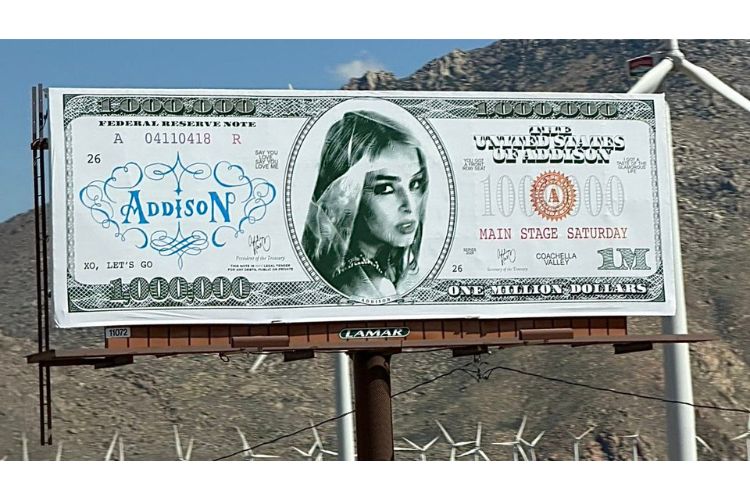
They're not subtle. And that is the point.
These aren’t the kinds of sights you encounter on your daily commute. They feel bigger, louder, and more expressive – almost like an extension of the stage itself.
What happens next?
People stop.
They snap photos.
They shared it massively.
That's where the real amplification starts.
The audience isn't just the people who are driving by. Everyone who sees that content online is also included. One picture can get dozens of likes, comments, and shares.
This pattern keeps happening over and over again. One great billboard can go a long way beyond where it is, just because it gives people something to remember.
At that point, the billboard is no longer just a place for ads.
It turns into content.
Why Interactive OOH Campaigns at Coachella Are Something Your Brand Can Copy
Even though Coachella seems like a unique place, the ideas behind its most successful billboard ads can be used in other places as well.
It's not just about the size or the money if you look at it closely. It's about how the idea comes to life.
Here are some things that brands can learn and actually use:
- Unique visuals, but still clear on the message
Bold and different things work, but clarity is still the most important thing. People should get it in a few seconds.
- 3D formats that elevate static billboards
You don't always need screens that are digital. 3D extensions on static billboards in Indonesia already get a lot of attention. Format shouldn't limit creativity
- Strategic placement with long visibility
People have time to notice and take pictures of open-road placements. That extra second or two is more important than you think. - Personalized messages based on location that feel relevant
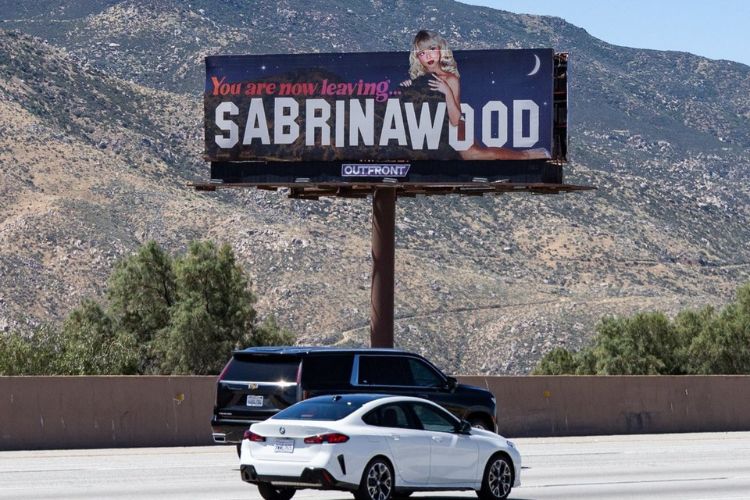
Simple location-based lines can make your campaign feel more relevant, just like Sabrina Carpenter's "You're now leaving the Sabrinawood."
Even something like this:
"Welcoming the Best Chips to Indonesia" can have the same effect.
I've seen similar executions in Southeast Asia, and the result is usually the same: people stop, take pictures, and share.
Your billboard can reach much farther than its physical location, and it doesn't cost more to do so.
Real campaigns that show interactive OOH works
This isn't just a theory. Companies have been trying this out for years, and some campaigns really stand out.
Spotify used data on how many people were listening to music in real time to change the billboards.
People saw things like this instead of generic messages:
"This song is the most popular in your city right now."
It felt like it was about me. That's what made it work.
What makes this interesting is that the interaction wasn't physical; it was mental. People could relate to the content because it was like them.
Why Interactive OOH Campaigns Work Better
There is a reason why brands are moving money here.
When it comes to:
- Ads Recall
- Engagement Time
- Social Amplification
From what I've seen, curiosity is the biggest motivator, not technology. People lean in when they don't fully understand what they're looking at.
Brands win at that moment, that pause.
I've also noticed that interactive OOH tends to get more organic reach.
People record it. Put it up. Put a tag on it.
Your billboard isn't just in one place anymore; it's everywhere.
When Interactive OOH Might Not Work (And That’s Totally Fine)
Not all campaigns have to be interactive.
And there are situations where static still works well:
- High-speed highways (very low dwell time)
- Basic brand awareness campaigns
- Restricted budget implementations
I’ve seen brands try to jam interactivity into the wrong place, and it just doesn’t perform.
So the real strategy isn’t “always go interactive.”
It’s knowing when it makes sense.
Interactive OOH Common Brand Mistakes
Not every interactive OOH campaign is a success. Many actually fail silently.
The typical problems are:
- Making the experience more difficult
People won’t get involved if it takes too long to understand.
Keep it intuitive.
-
- Poor Placement Strategy
Even the best creative doesn’t work in the wrong place.
Interactive OOH works best when:
• Areas with high dwell time
• Arrival points (airports, transit centres)
• Zones of events
-
- No Mobile Integration
Most interactions should go to mobile.
If you stop at the billboard, you’re only getting half the experience.
Measuring the Success of an Interactive OOH Campaign
This is where it gets interesting. Unlike traditional OOH, you can actually measure engagement.
Here’s what I usually check out:
Engagement Statistics
- QR code scans
- Interaction initiation
- Time spent
Behavioral Indices
- More search
- Location-based traffic to website visits
Social Amplification
- User-generated content
- Shares & mentions
Brand Lift
- Remember
- Considerateness
From my experience running campaigns, even a simple interactive layer can deliver a big lift in engagement over static placements in the same location.
What This Is Leading To In 2025
OOH isn’t just a media channel anymore. It’s becoming sort of a physical extension of the digital experience.
We are seeing more:
- AI powered personalisation
- Content tailoring in real-time
- Cohesion of the mobile ecosystem
And, frankly, audiences are demanding more these days.
A static billboard in a high energy environment such as Coachella?
It almost seems… outdated.
Why Choose Us?
At Firstboard, we do OOH differently.
Not as placements, but as experiences.
We’ve worked across a range of markets in Southeast Asia, helping brands turn high-traffic locations into high-impact touchpoints. We focus on the things that generate engagement, not just impressions, from strategic site selection to interactive concept development.
Because visibility alone just isn’t enough anymore in the end.
FAQ
What makes a successful interactive OOH campaign?
It has to be simple, interesting and rewarding. People should instinctively know what to do next and get something back — whether it’s entertainment, information or an experience they can share.
So, is interactive OOH more expensive than traditional billboards?
Not always. The production costs may be higher but the increased engagement and wider reach (especially through social sharing) often makes it more cost effective overall.
Where do you place interactive OOH for best results?
High dwell time locations are ideal – airports, transit hubs, event venues and busy pedestrian zones. Context is more important than volume of traffic.
Interactive OOH campaigns for small brands?
Yes but we need to scale the approach. Even simple things like QR-based experiences or dynamic messaging can build strong engagement without big budgets.
If you’re looking for ways to make your next OOH campaign more engaging, start with one simple question:
What would stop you for 5 seconds?
That’s where the best ideas tend to start.